
(a) The diagram shows the horizontal forces acting on a swimmer.

(a) (i) The swimmer is moving at constant speed.
Force T is 120 N.
What is the size of force D?
................................................... N
(1 mark)
-
(a) (ii) By increasing force T to 140 N, the swimmer accelerates to a higher speed.
Calculate the size of the initial resultant force acting on the swimmer.

Initial resultant force = .................................... N
(1 mark)
-
(a) (iii) Even though the swimmer keeps the force T constant at 140 N, the resultant force on the swimmer decreases to zero.
Explain why.

(3 marks)
-
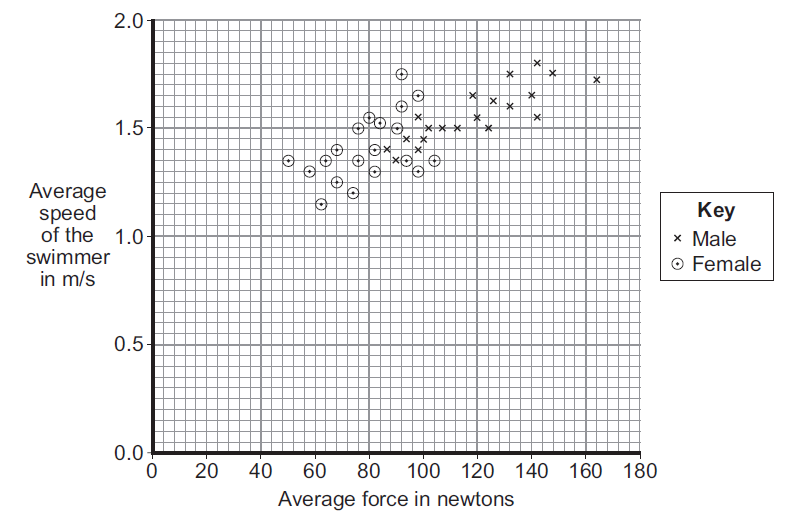
1 (b) A sports scientist investigated how the force exerted by a swimmer’s hands against the water affects the swimmer’s speed.
The investigation involved 20 males and 20 females swimming a fixed distance. Sensors placed on each swimmer’s hands measured the force 85 times every second over the last 10 metres of the swim.
The measurements were used to calculate an average force.
The average speed of each swimmer over the last 10 metres of the swim was also measured.
The data from the investigation is displayed in the graph.
(b) (i) What was the dependent variable in this investigation?
 (1 mark)
1 (b) (ii) Explain one advantage of measuring the force 85 times every second rather than just once or twice every second.
 (2 marks)
-
(b) (iii) Give one way in which the data for the male swimmers is different from the data for the female swimmers.
(1 mark)
(b) (iv) Considering only the data from this investigation, what advice should a swimming coach give to swimmers who want to increase their average speed?
(1 mark)
How did you do? Click to view the Mark Scheme Answers
From Q1 P2 AQA January 2011 (Higher)