

Become a Member to watch ad-free!
Forces and Their Effects on Objects
In this lesson, we explore what forces actually do to objects.
Rather than simply saying something “moves”, physics encourages us to describe motion
precisely using correct terminology. Forces can have several important effects, and
understanding these is essential for success in GCSE Physics.
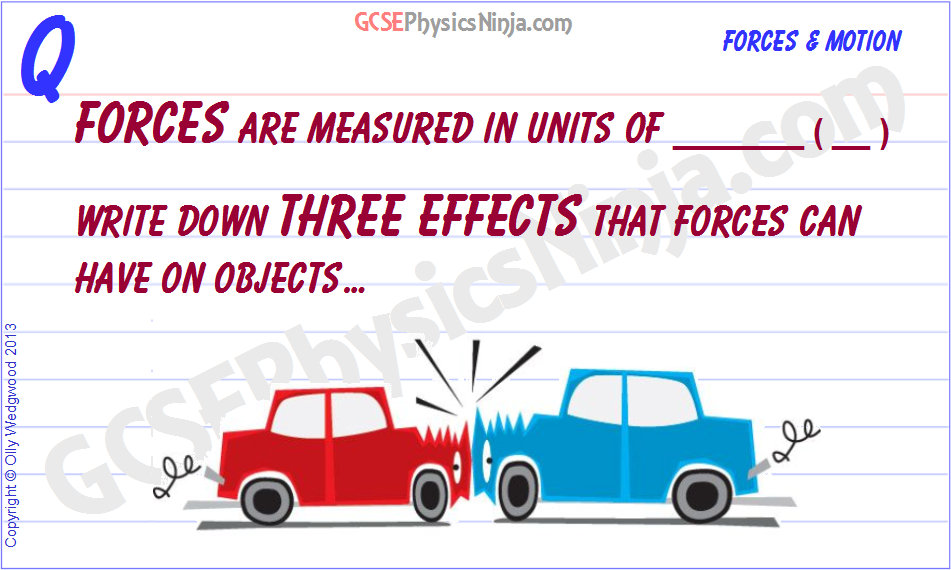
1. Forces Can Compress or Stretch Objects
One effect of a force is to compress or stretch an object. When you squeeze something
like a stress ball or push on a spring, you are applying a force that changes its shape.
In the case of a spring, this compression or tension allows energy to be stored as
elastic strain energy. This idea becomes especially important when studying
springs and Hooke’s Law later in the course.
2. Forces Can Accelerate Objects
A force can also cause an object to accelerate. In physics, acceleration does
not just mean “speeding up” — it means any change in velocity.
If a resultant force acts on an object, the object will accelerate. This could
involve increasing speed, decreasing speed, or changing direction. Using this vocabulary
correctly is very important in exam answers.
3. Forces Can Change Direction
Forces can also cause an object to change its direction of motion. A clear example of this
is an orbiting object, such as a moon orbiting a planet.
In an orbit, the object is constantly being pulled towards the planet by a force. This
force causes a continual change in direction, meaning the object is actually
accelerating even if its speed stays the same.
Although acceleration and change of direction are closely related, it is helpful at GCSE
level to think of them as separate effects of forces.
To summarise: forces can compress or stretch objects, accelerate them, or
change their direction. These ideas form the foundation of much of the forces
topic in GCSE Physics.